

Introduction: Why Material Selection Matters
1. Start With Booth Size, Usage, And Exhibition Objectives
The first step in choosing the Trade Show Booth Materials that will make the most impact at a trade show is to identify the goals that the booth will need to achieve in its limited space. When you have a 10×10 trade show booth, it is imperative to have the ability to plan materials, as all walls, counters, storage units, and graphics take up space. A trade show booth is a sales area that is 10×20 feet (3×6.5 meters) and is used for setting up areas for demonstrations, conversations, product exhibits and lead collection. The larger formats (20×20 Trade Show Booth) offer more structural flexibility, but also more requirements to fabricate, logistically, install and for materials.
- 10x10 Trade Show Booth: Ensure that you have a lightweight design, an excellent trade show booth backdrop, compact storage, and one efficient trade show display counter.
- Trade Show Booth 10x20: Break product presentations, meetings, demonstrations and reception areas into modular spaces to avoid a ‘crowded space '.
- Trade Show Booth 20x20: Mix permanent structures, architecture, display cases, meeting rooms and over branded use in accordance with the venue rules.
- Trade Show Booth 8x8: Simplicity is key in the material palette, portable trade show display components and high-visibility graphics.
2. Match Structural Materials To Performance Requirements
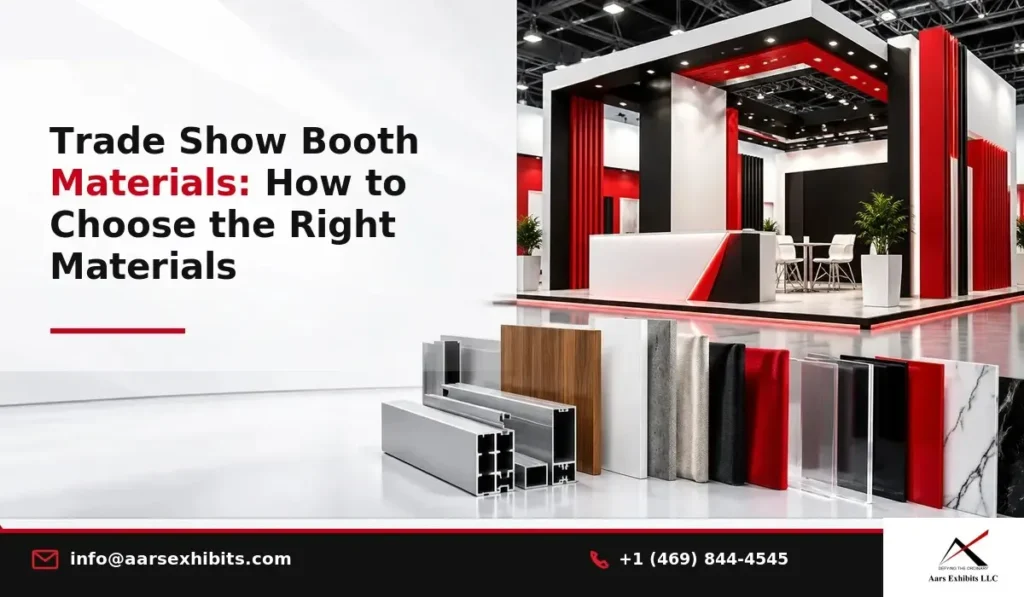
- Aluminium frame: ideal for modular systems that need repeat assembly, more manoeuvrability and flexible configuration.
- Composite Panels: Useful for a surface that is stiff and light, for graphic application or architectural detail.
- Acrylic and glass: Effective for product display, shelves, logos and top-notch presentation, but subject to handling and safety requirements.
3. Select Graphics And Surfaces For Brand Impact
Graphics tend to be the first material that visitors will see; thus, the substrate and printing process should foster brand identification and the artistic notion. Tension fabric can be used to offer seamless large-format surfaces and graphic panels to offer architectural rigidity. However, where branding, direction or surface graphics are an absolute requirement, vinyl still has a place.
- Tension Fabric: Lightweight, ideal for large, immaculate branded surfaces, curved surfaces and removable graphics.
- Graphic Panels: They are ideal for use on hard surfaces, on product information, for directions and for a structured exhibit design.
- Backlit Graphics: Incorporate controlled lighting into key brand messages, graphics, product imagery or architecture.
- Trade Show Booth Backdrop:Is a main branding area and should be readable from appropriate approaches.
- Brand Colour and Finish: Maintain the same brand color and finish throughout the walls, counters, displays and supporting graphics.
No good materials will help with bad content hierarchy. You should be able to tell what you have to offer to your exhibition and why they should be interested. Finishes should complement the creative approach and not detract from it. AARS Exhibits combines materials and messaging, lighting, graphics and visitor flow to ensure a cohesive exhibit.
4. Consider Flooring, Counters, Accessories, And Product Displays
The secondary components can directly impact the visitor’s action with the booth. Flooring can help to create the footprint and provide comfort, cable management and brand positioning. Counters are used to support the receiving or demonstration surface or to provide a surface for products to be shelved or displayed, without blocking sightlines. Visitor needs and staff requirements should guide the selection of trade show booth design accessories, rather than choosing items simply to fill space.
- Floors: Carpet, vinyl, laminate or raised floors depending on comfort, finish, cleanability, and how to manage cables and floor conditions.
- Trade show display counter: Select dimensions and storage capacity for reception, demonstrations, and staff workflow.
- Display Cases: Security, visibility or premium presentation is essential for the protection and visibility of products.
- Product Display: Place products at a practical height, allow for adequate circulation around demonstration areas.
5. Evaluate Reusability, Sustainability, Cost, And Compliance
- Long-Term Value: Take into account the number of shows, storage, repairs, transports, and graphic replacement when comparing the purchase/fabrication costs.
- Sustainable Materials: Where feasible, use reusables, recyclables, long-lasting finishes, and minimise single-use materials.
- Trade Show Booth Supplies: Standardize reusable trade show hardware and key elements to make future planning and logistics easier.
- Venue Compliance: Check structural, fire safety, height, electrical, weight, hanging and material specifications prior to production.
- Quality Control: Check samples, finishes, print accuracy, joints, hardware and installation before the final build.