
Why Lighting Matters In Trade Show Booth Design
The brand has just a few seconds to draw the attention of visitors in the exhibition hall. Thus, your Trade Show Booth Design needs to deliver visibility, clarity, and value before a sales conversation. Lighting can influence how visitors react to the first thing they see.
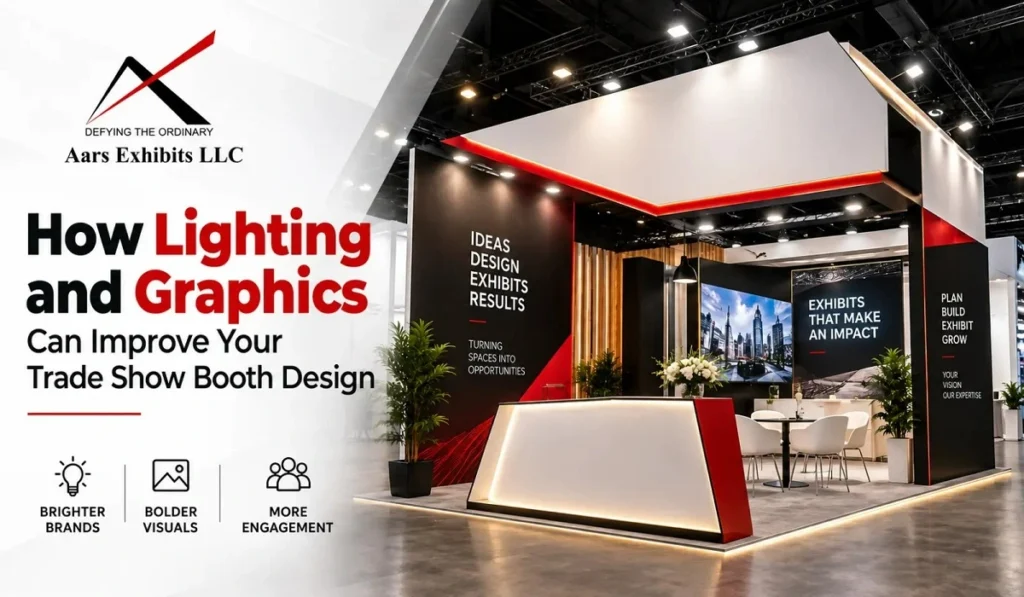
In B2B shows, lighting should be part of the general design of the booth, but not a decoration. Use lighting to direct attention to a product, demonstration, meeting space or message. Uniform lighting can also help create a consistent presentation throughout the booth. A U.S. trade show booth builder can coordinate the booth design, lighting, graphics, product displays, and visitor flow within the booth’s footprint.
Use Lighting To Direct Visitor Attention
Lighting can create a clear visual hierarchy in your booth. Don’t light all surfaces the same; apply varying light levels to determine priority areas.
Consider these applications:
- Give a spotlight to a flagship product.
- Create architectural edges and counters with linear LEDs.
- Light up entryways to enhance interactions with visitors.
- Include backlighting for high-value brand graphics.
- Have even lighting for product information panels.
This helps guide visitors toward what to see, where to go, and what to do next. It also helps generate leads in the lead-generation areas as it simplifies conversations, demonstrations and presentations.
Graphics Make Your Brand Message Clear
Graphics are one of the primary tools for communicating your brand message. Their job is to convey your brand, solution and your value proposition in a very limited amount of time. The larger the graphic, the more visible it is from the aisle, while smaller graphics can provide supporting information for visitors.When designing graphics, prioritize clear information over excessive detail. Generally, the brand should come first, followed by the main message and supporting information.
When considering a booth design solution in the USA, companies should start with their marketing objectives and then create a graphics plan. Product launches, lead generation, distributor meetings, and technical demos can come in a variety of messaging formats.
Combine Lighting And Graphics For Greater Impact
Lighting and graphics should be created in unison as one visual system. A strong graphic can still be difficult to read if it is poorly lit. Good lighting enhances clear messaging, but it cannot replace it. Fabric graphics can be used to form a clean visual focal point that can be produced using backlighting. Edge Lighting can highlight architectural elements. Spotlights can be used to enhance product photography and key headlines. Selected brand colors can also be accented with LED lighting without overpowering the display.
This integration should be considered when designing booths for U.S. projects. The team can coordinate placement, viewing angles, material choices, electrical needs, and visitor sightlines before fabrication.
Choose Lighting According To Booth Objectives
The various booth areas require various types of lighting. General lighting can help to provide overall visibility. Accent lighting can be used to highlight priority products. Because of its ability to enhance the design language, decorative lighting can be incorporated in the design when used sparingly.
Some questions to consider when planning:
- Which product should receive immediate attention?
- Where is an appropriate stopping point?
- Which message should visitors see from the aisle?
- Does lighting glare onto screens?
- Do graphics make sense in a real venue?
The following questions help you see lighting as part of the exhibit strategy.
Plan Graphics For Distance And Readability
Trade show graphics are viewed from different distances. A headline needs to be visible from the aisle, while supporting copy can provide additional information to visitors inside the booth.
Keep important messages concise. Use high contrast, readable text sizes, and consistent branding. Avoid placing too much text across every wall. Images, diagrams, benefit claims and brief calls to action can convey more complex offerings in a more efficient manner.
Graphics’ interaction with structural parts should also be taken into account when working with a Trade show booth builder in The USA main message should not be blocked by other elements such as columns, counters, storage walls, hanging signs or screens.
How AARS Exhibits Approaches The Design Process
AARS Exhibits develops booth concepts based on the BRIOS – brand goals, visitor traffic, and exhibition needs. The design solution integrates custom booth architecture, graphic communication, placement of lights and functional areas in a coordinated design.
The process for an exhibitor looking for trade show booth design in USA services can include concept development, 3D visualization, material planning, graphic integration, fabrication, installation and on-site support.
The purpose isn’t just to light up a booth or make it more vibrant and colorful. It’s to develop a presentation in which all visual elements are used to assist business communication.
Make Lighting And Graphics Part Of The Strategy
Effective Trade Show Booth Design is a combination of visibility and communication. Lighting attracts attention, and graphics provide the information on why people should halt and interact. By aligning both efforts with product, messaging and foot traffic, the booth will provide a more structured and professional brand experience.
AARS Exhibits assists companies in making the transformation from marketing goals to real-world exhibits. Lighting, graphics, architecture and execution can all help to convey your message from the aisle to the meeting table with your booth.